+86 15253215219


- 23 Oct 2026
Why Sustainability Has Become the Main Driver of Plant-Based Litter Exports
October 23, 2026, marks International Snow Leopard Day — a rare predator that has become a symbol of preserving the mountain ecosystems of Central Asia. On the same day, industry news from China shows how sustainability and circular economy principles are turning food waste into a sought-after export product — plant-based cat litter. For distributors and brands, these two events add up to one signal: ecology is no longer a marketing bonus; it has become a key competitive factor on the shelf.
1. Snow Leopard Day: Ecology as a Global Value
International Snow Leopard Day is observed annually on October 23. The date was established to draw attention to the conservation of one of the most vulnerable big cat species — only a few thousand individuals remain in the wild, with poaching and habitat loss as the main threats.
For the pet industry, this holiday is a reminder of broader responsibility. Domestic cats and their wild relatives share common biology, but their well-being depends on different factors: for the snow leopard, it's ecosystem preservation; for the domestic cat, it's the quality of the environment humans create, including what's in the litter box. Eco-friendly, safe, and biodegradable litter is part of the same responsible consumption logic that underpins nature conservation.
2. What's Happening in the Market: Food Waste Becomes an Export Commodity
While the world talks about preserving rare species, Chinese plant-based litter manufacturers are demonstrating how sustainability works in practice.
Exports are growing at double-digit rates. According to Yantai customs, in the first nine months of 2026, 5.67 million tons of pea-based litter passed through just one port — 33.4% more than a year earlier. One manufacturer from Zhaooyuan increased exports by 41.8% to 6,523 tons in the first eight months. In Xuzhou, January–July 2026 exports reached 4.05 million tons worth 196 million yuan, up 42.1% and 36.3% respectively.
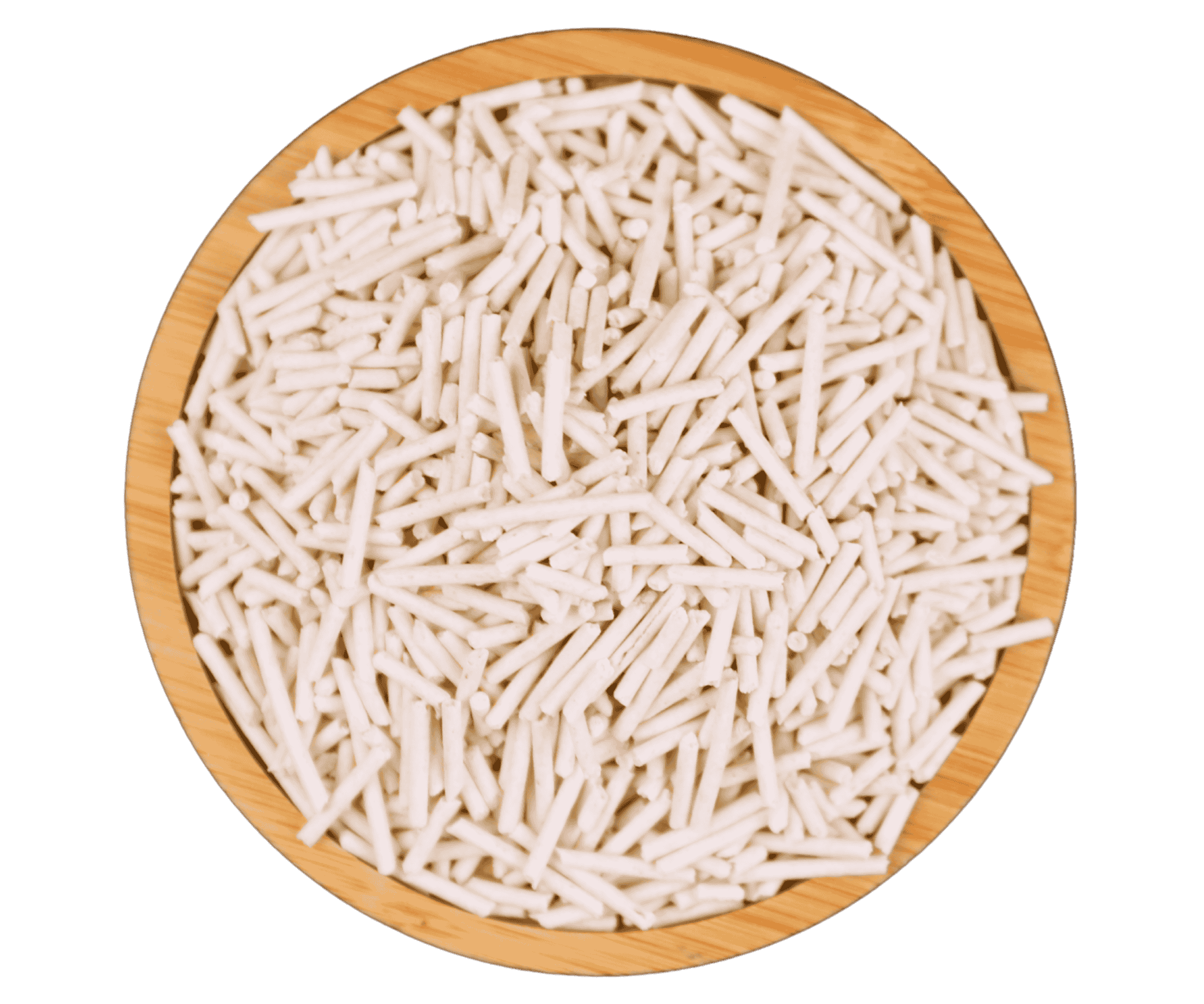
Raw material is a food production by-product. These shipments are based not on mineral raw materials but on pea and soy pulp left after legume processing. In Zhaooyuan County, known for glass noodle production, pea pulp used to be a low-value waste. Now it's turned into litter with high absorbency, fast clumping, and full biodegradability. A similar story is in Liaocheng, where soy pulp is turned into tofu litter: over 3,200 tons exported to 13 countries in a year, including Russia, the US, and Indonesia.
Why this matters for distributors. This production model solves two problems at once: food waste utilization and creating a value-added product. For buyers, it means stable raw materials, low cost, and a "green" story to use in marketing. For the market, it means reduced dependence on bentonite, whose extraction has an irreversible impact on landscapes.
3. Innovation: Litter Becomes a Health Monitoring Tool
Alongside export growth, the product line is evolving. In early October 2026, Qingdao-based Magnet Cat Litter introduced Cassava Health Monitoring Cat Litter 2.0 — a plant-based litter made from corn and cassava starch with a color-changing urinary pH indicator.
How it works: if the cat's urine pH is normal, the clump color doesn't change. When urine becomes overly acidic, the clump turns pink (potential risk of calcium oxalate); when overly alkaline, it turns blue (potential risk of struvite, urinary tract infections, or cystitis). The color stays visible for more than 72 hours, giving owners time to consult a veterinarian. The formula is free from silica, formaldehyde, aflatoxins, mold, and salmonella; clumps form in three seconds without artificial binders.
This example shows that plant-based litter is ceasing to be just a "consumable." It's becoming a product with functional value — and that opens up the opportunity for brands to sell it in the premium segment with a clear advantage.
4. Hybrid Formulas: The Next Step in Evolution
Another trend confirmed by Asian manufacturers is raw material blending. On October 19, Korean brand Popomong (Kleen Nara) launched a hybrid litter "Cassa-Tofu" based on soy pulp with added corn and cassava starch. Claimed metrics: clump strength 96%, odor removal 99.1%, dust level 0.3%, fragrance-free, formaldehyde and aflatoxins not detected.
Hybrid formulas address the limitations of single-product lines: tofu provides recognition and low cost, cassava — low dust and neutral aroma, bamboo — antibacterial properties. Together they create a product that is harder to copy and easier to position in the mid and premium segments.
5. What This Means for Distributors and Brands
First, sustainability is no longer an "additional" argument. For European markets, where waste disposal is a pressing issue, and for Asian markets, where climate accelerates odor development, plant-based litter with confirmed biodegradability and low dust is no longer a niche but a core demand.
Second, Asian manufacturers are actively seeking direct export channels. Export growth of 30–40% per year means supply is rising, and distributors have more options for negotiation. But along with quantity, the quality spread is growing — so verifying characteristics (dust, clumping, stickiness, certificates) remains essential.
Third, functional products (health monitoring, hybrid formulas) open up opportunities for differentiation. The shelf is getting crowded with "just tofu" and "just cassava." A product with concrete numbers and a clear benefit sells more easily.
6. Checklist: What to Look for in Plant-Based Litter
Raw materials. Food-grade starch, soy or pea pulp, bamboo fiber. If the manufacturer uses food production by-products, that's a plus for both cost and ecology.
Dust level. ≤0.3%, with the best samples at ≤0.2%, and premium cassava at ≤0.1%.
Clumping speed. 3–5 seconds; more than 8–10 seconds is weak for premium.
Behavior after wetting. Granules should not turn into a sticky mass or stick to paws.
Certificates. ISO 9001, ISO 14001, EU REACH, SDS, toxicology reports.
Biodegradability. If ecology matters for your market, choose a product that decomposes quickly and leaves no slag.
7. Why This Matters on October 23
Snow Leopard Day reminds us of the fragility of ecosystems. News from China shows that business can be part of the solution, not just a source of the problem. Plant-based litter made from food waste, with low dust and confirmed biodegradability, is not just a product. It's an example of how the economy closes the loop.
For a cat owner, choosing such litter is a small step. For a distributor, it's an opportunity to offer the market a product with a story. And for the industry, it's a move toward standards where quality and sustainability stop being mutually exclusive.