+86 15253215219


- 05 Nov 2026
The Carbon Footprint of Cat Litter: What's Hidden Behind the Packaging
While some argue about price per ton, others calculate carbon footprint. For distributors and brands, this is no longer abstract ecology but a concrete factor in choosing a supplier. Here's how different litter types affect CO₂ emissions and why plant-based formulas win.
1. Why Carbon Footprint Has Become Important for the Market
The European Union is introducing the Carbon Border Adjustment Mechanism (CBAM), retailers increasingly demand emissions data from suppliers, and consumers read packaging more carefully than ever. Cat litter is no exception.
It's estimated that an average household with one cat uses 8–12 kg of litter per month. That's 100–150 kg per year. Multiply by millions of households, and you get hundreds of thousands of tons of raw material that must be extracted, processed, packaged, and delivered.
A litter's carbon footprint consists of several stages:
Raw material extraction and production (bentonite, wood, starch, soy pulp).
Transportation of raw materials to the factory.
Production (granulation, drying, packaging).
Delivery of finished products.
Disposal after use.
Each stage contributes differently. And this is where plant-based litters show an advantage.
2. Bentonite vs Plant-Based Raw Materials: Emissions Comparison
Bentonite is a mineral raw material extracted by open-pit mining. Extraction, crushing, drying, and transportation require significant energy inputs. In addition, bentonite does not biodegrade and after use goes to landfill, where it remains for decades.
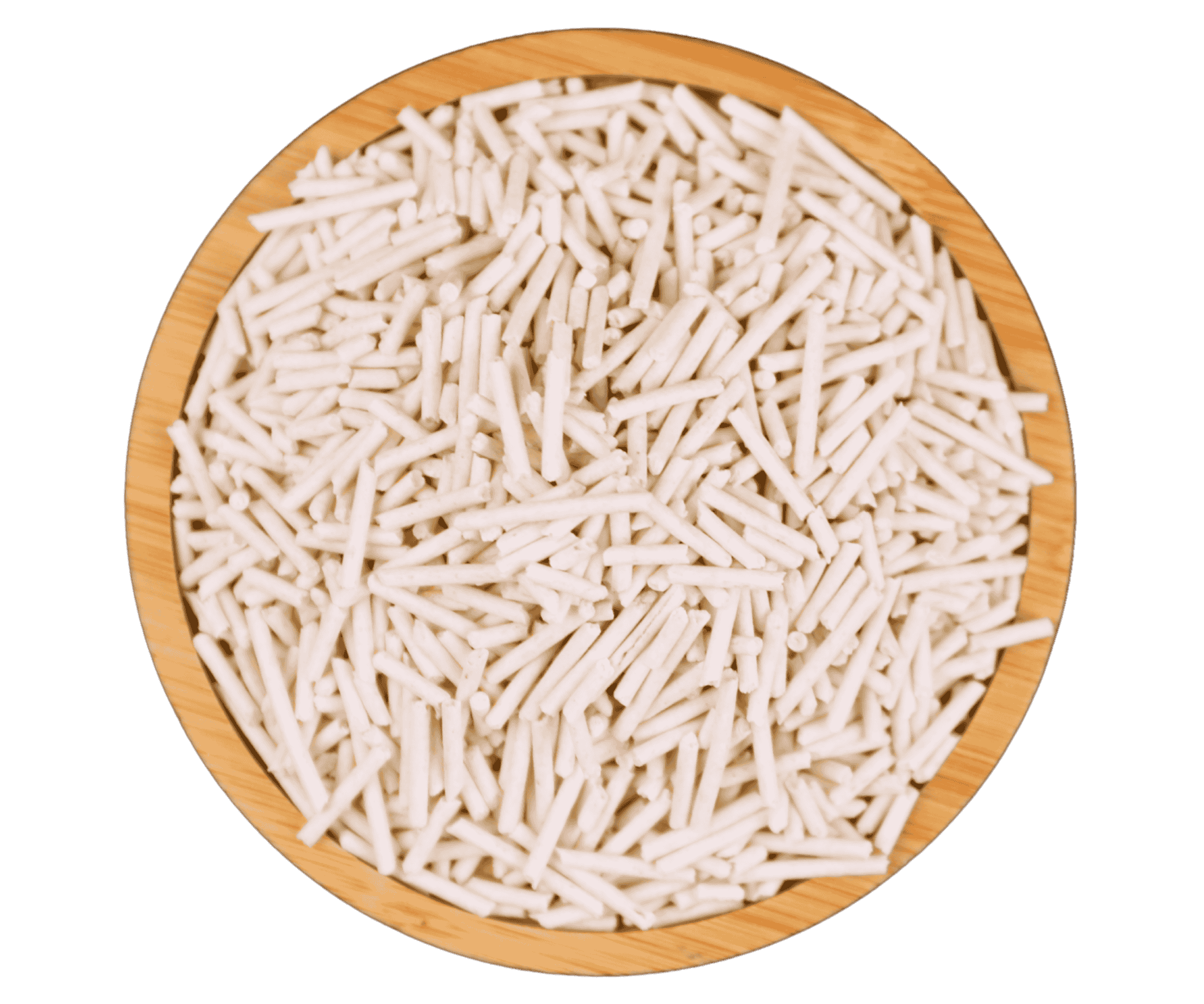
Plant-based raw materials (cassava, corn starch, soy pulp, bamboo) are renewable resources. Many of them are by-products of food production — for example, soy pulp or pea starch. Using them in litter means waste gets a second life instead of rotting in a landfill.
According to research, the carbon footprint of plant-based litter can be 30–50% lower than that of bentonite, depending on the raw material and logistics.
3. Transportation: Why "Location Matters"
Even the most eco-friendly litter can have a high carbon footprint if it's shipped halfway around the world. For example, bentonite is often mined in China and shipped to Europe by sea — thousands of kilometers.
Plant-based litter produced in Qingdao (China) also travels a long way to Europe. But there's a nuance: loading density. Plant-based litter is lighter, so more packages fit into a container. This reduces emissions per ton of product.
In addition, many plant-based litter manufacturers locate factories closer to raw material sources — for example, in pea or soy production areas. This shortens the transport leg.
4. Production: Where the Savings Are
Producing plant-based litter requires less energy than mining and processing bentonite. Starch granulation occurs at lower temperatures, and drying takes less time.
In addition, plant-based raw materials often don't require chemical treatment — mechanical processing and granulation are enough. This reduces not only emissions but also the risk of environmental contamination.
5. Disposal: The Main Advantage
This is perhaps the most important stage. Bentonite after use goes to landfill, where it does not biodegrade. Plant-based litter is biodegradable, and some types can even be composted (though not recommended due to sanitary standards).
In Switzerland, where landfills are overflowing, plant-based litter is recommended as a solution to the problem. After incineration, it yields energy, not slag.
6. What Gilancy Does to Reduce Its Carbon Footprint
At Gilancy, we understand: carbon footprint is not an abstraction. That's why we take concrete steps.
Raw materials. We use food-grade cassava and corn starch, soy pulp, and bamboo fiber. Many of these materials are by-products of food production. This reduces the burden on primary resources.
Production. Our Qingdao factory is equipped with two automated lines that optimize energy consumption. We continuously work on reducing energy use.
Packaging. We offer packaging made from recyclable materials and big bags for wholesale supplies — this reduces the amount of plastic.
Logistics. We optimize container loading to reduce emissions per ton of product.
Certificates. We hold ISO 14001 — the international standard for environmental management. This confirms that our processes meet high environmental requirements.
7. What This Means for Distributors
If you work with European retailers or brands that value sustainability, carbon footprint data becomes a competitive advantage.
Here's what you can do right now:
Request emissions data from the manufacturer. If they can't provide it — that's a reason to think twice.
Compare not only price but also carbon footprint. Sometimes a more expensive product turns out to be more cost-effective in the long run.
Use environmental advantages in marketing. Buyers value transparency.
Choose suppliers with ISO 14001. This guarantees that environmental aspects are actually managed.
8. Why This Matters
Carbon footprint is not just a buzzword. It's a factor that increasingly influences supplier choice, shelf placement, and brand reputation. Plant-based litter with food-grade raw materials, low dust, and ISO 14001 certification is not only eco-friendly but strategically sound.
At Gilancy, we're ready to provide data on our carbon footprint and discuss how our product can help your business become more sustainable.