+86 15253215219


- 02 Nov 2026
5 Myths About Plant-Based Cat Litter That Hurt Sales
Plant-based cat litter is growing faster than the market. But on the shelf, it still faces prejudices — from both buyers and sellers. Here are five common myths that reduce sales, and what to do about them.
Myth 1. "Plant-based litter is more expensive, so it's not worth it"
The objection: "Why pay more if bentonite does the job?"
The reality: the price per kilogram of plant-based litter is indeed higher. But you should compare not the price of the package, but the cost of a month of use.
Plant-based litter usually requires a thinner layer (3–4 cm instead of 5–7 cm), clumps faster, and requires full replacement less often. Per month of use, the difference is often not as significant — especially considering that bentonite needs to be changed more frequently.
What to do: calculate not the price per kg, but the cost per month. And show it to the customer: "one package lasts X weeks."
Myth 2. "Plant-based litter doesn't control odor well"
The objection: "Natural can't fight odor as well as mineral."
The reality: odor control depends not on the origin of the raw material but on the mechanism of action. Mineral litters often just absorb moisture, while plant-based litters can adsorb and break down ammonia — for example, through the porous structure of starch and bio-enzymes.
Modern plant-based litters with seaweed extract and bio-enzymes show odor removal up to 98.1% and control for up to 14 days. This is no worse, and sometimes better, than mineral analogs.
What to do: ask the manufacturer for test reports. If the numbers are there — use them in POS materials.
Myth 3. "Plant-based litter tracks all over the apartment"
The objection: "The granules are light, the cat spreads them around."
The reality: the problem is not the plant-based raw material but the size and shape of the granules. Large, light granules can indeed stick to paws. But modern plant-based litters are made with granules of 0.5–3 mm — they are soft, don't injure paws, and stick less.
The Roskachestvo inspection showed that the stickiness problem also exists in wood-based litters — half of the samples stuck to paws after wetting. So it's not a "plant-based" problem but a product quality problem.
What to do: test the litter for stickiness after wetting. A good product should not turn into a sticky mass.
Myth 4. "Plant-based litter is dangerous if a cat eats it"
The objection: "What if the cat swallows a granule?"
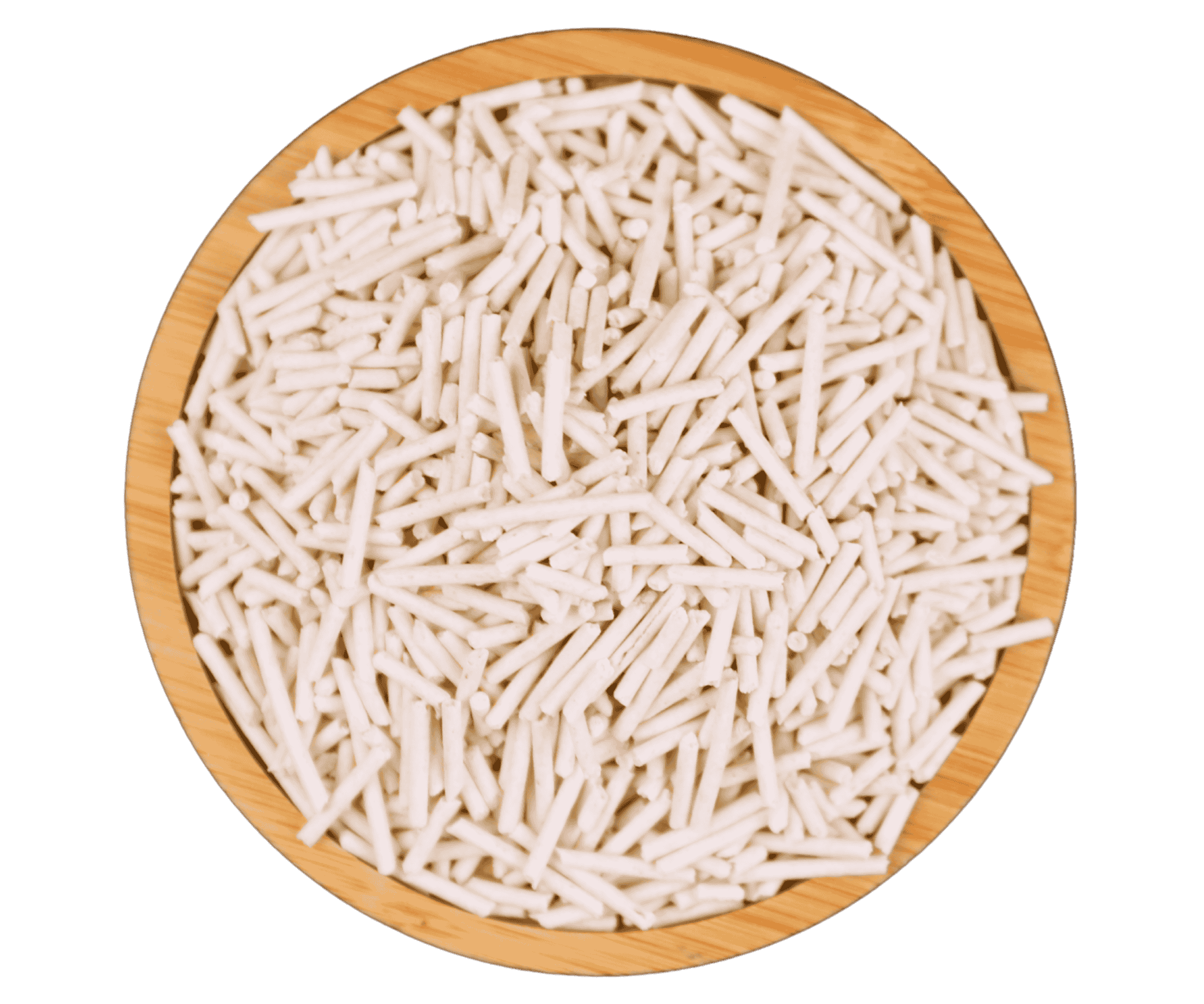
The reality: if the litter is made from food-grade raw materials — corn or cassava starch, soy fiber, bamboo — the risk of accidental ingestion is minimal. It's not chemicals; it's essentially a food product.
Another matter is litter with toxic additives (triclosan, borax, benzalkonium chloride). But this is a question of the manufacturer's integrity, not of plant-based raw materials.
What to do: look at the composition. If the raw materials are food-grade — that's a plus. If there are toxic components — that's a minus, regardless of the litter type.
Myth 5. "Plant-based litter is a niche for eco-fanatics"
The objection: "Only those obsessed with ecology buy it."
The reality: people choose plant-based litter not only for ecology. The main drivers are low dust, cat health, and cleaning convenience. Owners of sensitive cats, senior animals, cats with asthma or arthritis — these are not "eco-fanatics" but people who need a practical product.
According to QYResearch, the global plant-based litter market will reach USD 2.77 billion by 2032 with a CAGR of 8.8%. This is no longer a niche.
What to do: don't sell plant-based litter only as "eco." Sell it as a solution to problems: less dust, faster cleaning, safer for the cat.
How to Use These Myths in Sales
Train the staff. Salespeople in pet stores often believe these myths themselves. Give them simple answers and numbers.
Place POS materials. Cost-per-month comparison, test reports, composition — all of this works better than the words "natural" and "eco-friendly."
Collect reviews. Real stories from owners who switched from bentonite to plant-based litter and noticed the difference convince better than any advertising.
Give samples. A small trial package removes the fear of "what if I don't like it."
Why This Matters
Plant-based litter is not a "fashion trend" but a product that solves specific problems. But for it to sell, myths need to be dispelled — both among buyers and sellers.
If you represent a brand or a store and want to launch a plant-based litter line, Gilancy is ready to help: we will provide samples, test reports, and staff training materials. Our cassava litter has a dust level of ≤0.1%, and bamboo — ≤0.2%. We work with food-grade raw materials and offer OEM from one ton.