+86 15253215219

- 09 Oct 2026
November 9: World Quality Week, Waste Congress, and Sawdust Innovations
On November 9, 2026, World Quality Week begins, the ISWA waste management congress opens in London, and the Kirov region continues producing cat litter from sawmill waste. Three events — one common theme: quality that starts with raw materials and ends in the cat litter box.
1. World Quality Week: "Russia — a Country with the Quality Mark"
On November 9, World Quality Week kicks off and runs through November 15. The culmination will be World Quality Day on November 12. This year's motto is "Russia — a Country with the Quality Mark."
Quality Day in Russia aims to draw attention to the key components of quality of life: the environment, the social sphere, healthcare, family values, and traditions. It is a platform for open dialogue between domestic manufacturers, retail chains, and consumers, whose choices largely shape the market.
This is especially relevant for the pet industry. The Roskachestvo inspection we wrote about in September showed that underweight, excessive dust, poor odor retention, and sticky granules are real problems faced by litter buyers. Quality Week is a good occasion to check what's written on your litter's packaging and to ask the manufacturer some uncomfortable questions.
2. ISWA World Congress 2026: "Create Legacy"
On the same day, November 9, the ISWA World Congress — the International Solid Waste Association's global event — opens in London. The event takes place at the QEII Centre and runs through November 11. This year's theme is "Create Legacy."
The congress brings together the global waste and resource management community to discuss how innovation, collaboration, and sustainable infrastructure help cities create long-term change.
Key topics include the transition from traditional waste collection to cleaner, safer, and more efficient urban solutions. Envac, one of the congress participants, will present an automated vacuum waste collection system that reduces traffic, cuts carbon emissions, and supports long-term sustainable urban development.
The connection to cat litter here is direct. In Switzerland, which we wrote about in September, bentonite litter makes up about 4.4% of the weight of an average household waste bag and, after incineration, leaves slag that must be landfilled. Plant-based litter burns almost without residue. This is not abstract ecology — it is a concrete burden on urban infrastructure.
3. Sawdust Innovations: Russian Litter Made from Corn Starch
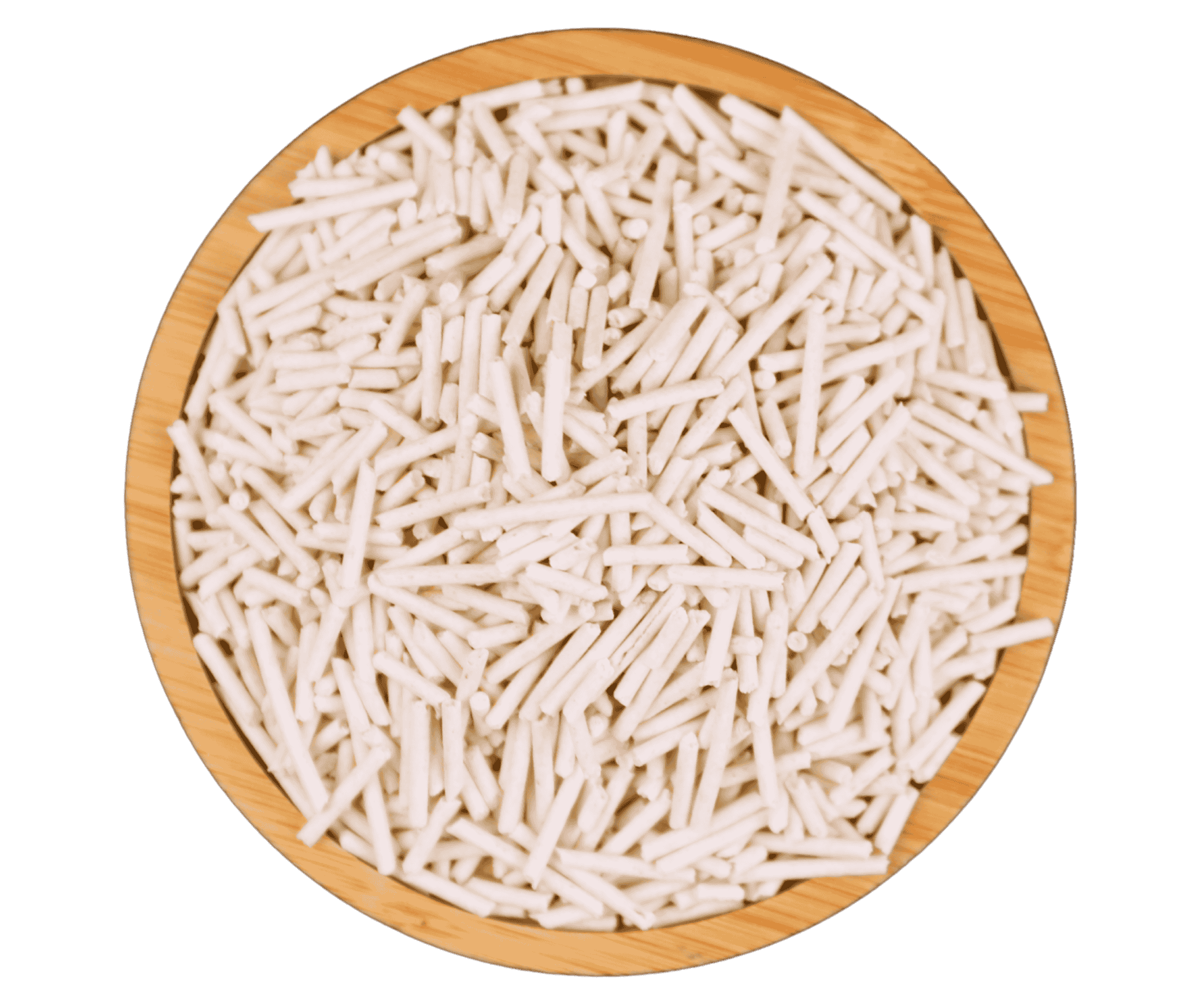
While the world discusses waste management, Russian manufacturers are taking a step toward sustainable production. In the Kirov region, the company Komvest has launched production of cat litter using a patented technology — from corn starch and organic fibers of coniferous wood, i.e., sawmill waste.
The project is being implemented as part of the "Lean Forest of Vyatka" initiative with support from the Rosatom corporation. The enterprise received a preferential loan to purchase a microwave unit with climate control. The finished product, according to the manufacturer, absorbs moisture well and neutralizes unpleasant odors.
This example illustrates a trend we have observed all year: litter is ceasing to be just a consumable and is becoming a product that solves two problems at once — waste utilization and the creation of a sought-after product. By accepting low-grade wood and sawmill waste for processing, enterprises solve two problems at once: preventing new wood waste landfills and creating value-added products.
4. "Zoomir" in Krasnoyarsk: Three Days Dedicated to Pets
From November 9 to 11, the "Zoomir. Domestic Animals" exhibition is being held in Krasnoyarsk at the MVK "Sibir" center. Thousands of animals and birds, leading breeders, pet product and feed manufacturers, charitable organizations, and animal shelters gather under one roof.
November 9 is dedicated to grooming: as part of the exhibition, the all-Russian "SibirGroom" competition among professional groomers will take place. More than 25 participants from various cities will cut, style, and brush dogs. Well-known Russian groomers from Moscow and Samara will serve as experts.
5. Checklist: What to Look for When Choosing Litter
Quality Week is a good occasion to reconsider what you buy for your cat. Here are practical criteria.
Dust level. For plant-based litters, quality manufacturers state this indicator. The benchmark is less than 0.3%, and the best samples achieve ≤0.2%. This is important for the cat's breathing and for homes where someone is prone to allergies.
Behavior after wetting. Granules should not turn into a sticky mass. The Roskachestvo inspection showed that this is one of the most common problems — and one of the most unpleasant for the cat.
Odor retention. A good plant-based litter adsorbs and decomposes ammonia rather than masking it with fragrance.
Composition and origin of raw materials. Look at the raw materials: food-grade starch, soy fiber, bamboo fiber. If the manufacturer uses food-grade ingredients, the risk of accidental ingestion of particles is minimal.
Biodegradability. If ecology matters to you, choose a litter that decomposes quickly and does not leave slag behind in landfills.
6. Why This Matters on November 9
November 9 brings together three themes: quality, sustainable development, and innovation. World Quality Week reminds us that quality is not just "well made" but also "safe for everyone." The ISWA congress shows that waste management is a global task that begins in every home. And the Kirov litter made from sawdust proves that innovation can be simple and useful.
For a cat owner, this means one thing: choosing litter is not a trivial matter. It is a decision that affects the pet's health, the environment, and quality of life as a whole.