+86 15253215219


- 19 Oct 2026
Seven Questions to Ask a Litter Manufacturer Before Signing a Contract
Distributors and brands often choose a supplier based on price per ton. That's understandable — margin matters. But a price without answers to the seven questions below can turn into returns, complaints, and lost customers. Here's what to clarify before you wire the deposit.
1. What is your actual dust level — and how do you prove it?
"Low dust" on the packaging means nothing. Ask for a specific number. The benchmark for plant-based litters is below 0.3%, with the best samples at ≤0.2%, and some cassava products at less than 0.1%.
Ask for a test report. If the manufacturer answers "ours doesn't dust" without numbers — that's a red flag.
Why this matters for distributors: dust is one of the main causes of negative reviews and returns. The 2026 Roskachestvo inspection found that two out of 20 litters exceeded the technological dust limit. Your customers will notice.
2. How many seconds does it take to form a clump?
Fast clumping isn't just convenience — it's hygiene: the less time urine contacts the air, the less ammonia is released. A good indicator is 3–5 seconds.
Ask for a video or run the test yourself: pour litter into a tray, add water, and time it. If the clump forms in more than 8–10 seconds, that's weak for the premium segment.
3. What happens to the granules after wetting?
Almost nobody checks this parameter, and that's a mistake. Half of the samples in the Roskachestvo inspection stuck to paws after wetting. Cats lick their paws — and if the granules contain something unsafe, it goes inside.
Ask the manufacturer: do the granules pass a stickiness test? Is there tracking data?
4. What is the product made of — and can it be swallowed safely?
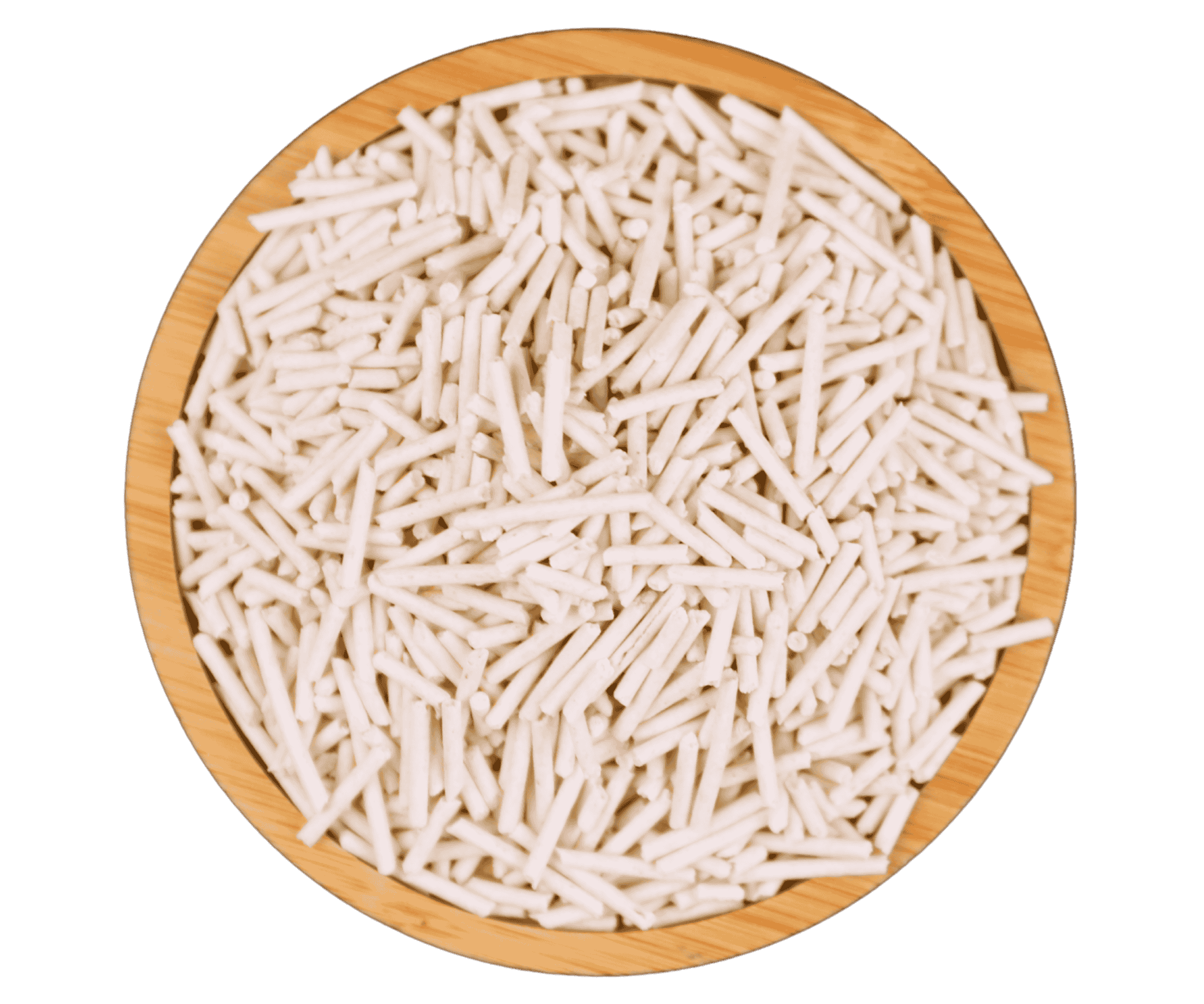
For plant-based litters, the key question is food-grade raw materials. Corn starch, cassava starch, soy fiber, bamboo fiber — if these ingredients are food-grade, the risk of accidental ingestion is minimal.
Ask for raw material certificates. And specifically check: does the composition contain triclosan, borax, benzalkonium chloride, glutaraldehyde, or zinc pyrithione? These substances can be harmful to cats.
5. How many tons per day do you actually produce?
This is a question about stability, not capacity. If the factory says "150 tons per day," clarify: is that peak capacity or monthly average? Is there finished goods stock in the warehouse?
Practical benchmark: a good manufacturer keeps at least 100 tons of standard items in stock. That means your order ships the day it arrives, not three weeks later.
6. What certificates do you have?
The minimum set for export shipments:
ISO 9001 — quality management;
ISO 14001 — environmental management;
EU REACH — for European supplies;
SDS — safety data sheet;
toxicology reports.
If the manufacturer can't provide these documents, working with them is a risk to your brand.
7. What's included in OEM, and what costs extra?
OEM isn't just your sticker on the packaging. Clarify:
who develops the packaging design;
is printing included in the price;
can the formula be changed (e.g., add a scent);
what's the minimum run for custom packaging;
are samples free.
Tip: request samples before signing the contract. Test them yourself: pour, add water, check the dust. Nothing replaces a hands-on test.
Bonus: Quick-Check Checklist
| Question | Good answer | Red flag |
|---|---|---|
| Dust level | ≤0.3%, with a report | "Doesn't dust" without numbers |
| Clumping speed | 3–5 seconds | More than 10 seconds |
| Stickiness after wetting | Test passed | No data |
| Raw materials | Food-grade | "Secret" |
| Warehouse stock | 100+ tons | "Made to order" |
| Certificates | ISO + REACH + SDS | Just "we have a certificate" |
| OEM | Transparent terms | Hidden surcharges |
Why This Matters
A distributor doesn't earn from the price difference per ton — they earn from repeat orders. And repeat orders come when the customer is satisfied. The seven questions above are a way to check whether the manufacturer can deliver that "satisfied" consistently.